1.6 Acceleration as the Derivative of Velocity
Hook: The Speedometer Lie
You're in a car. The speedometer reads a steady 60 km/h. You glance at it again a few seconds later -- still 60. The needle hasn't moved.
Are you accelerating?
Your gut probably says no. The speed isn't changing, so how could you be accelerating?
But now imagine that car is rounding a highway curve. Your body presses against the door. The tires grip harder. Something is clearly happening -- something is changing -- even though the speedometer hasn't budged.
So what is changing, if not the speed?
This is the question that breaks open a common misunderstanding of acceleration. And it turns out the answer lives in the same calculus tool you used in Section 1.5 -- the derivative -- applied one level deeper.
Prediction: Which Motions Involve Acceleration?
Before we define anything formally, consider three scenarios.
Scenario A: A car on a straight highway presses the gas pedal and speeds up from 40 km/h to 80 km/h.
Scenario B: A car on a straight highway applies the brakes and slows from 80 km/h down to 40 km/h.
Scenario C: A car enters a circular roundabout and drives around it at a perfectly constant 40 km/h.
Prediction: Which of these three scenarios involve acceleration? Select all that apply before reading on.
(a) Only Scenario A (b) Scenarios A and B (c) All three -- A, B, and C (d) None of them
Lock in your answer. We'll come back to it.
The Need for a New Quantity
In Section 1.5, you learned that velocity tells you how position is changing:
$$v(t) = \frac{dx}{dt}$$
This was powerful. Given any position function $x(t)$, you could extract a complete description of how fast the object moves and in what direction, at every instant.
But velocity itself can change. A car can speed up. A ball tossed upward slows, stops, then reverses. A planet in orbit continuously shifts direction. In every one of these situations, the velocity at one moment is different from the velocity at the next.
We need a way to describe how velocity changes. Not what the velocity is, but how it is evolving.
This is exactly the same situation we faced in Section 1.5, one level up. There, we asked: "Position is changing -- how do we describe the rate of that change?" The answer was the derivative. Now we ask: "Velocity is changing -- how do we describe the rate of that change?"
The answer, once again, is the derivative.
Exploration: Shaping Acceleration on a Velocity Graph
To build intuition for acceleration before writing any formulas, work through the following interactive component.
[Interactive: A velocity-time graph with a draggable curve. The horizontal axis is time $t$, the vertical axis is velocity $v(t)$. Students can click and drag control points to reshape the velocity curve. Below the graph, the instantaneous acceleration $a(t)$ is displayed as a numerical value that updates in real time as the curve changes. A second panel shows the corresponding $a(t)$ graph, synchronized with the $v(t)$ graph above it.]
Work through these guided prompts:
Prompt 1: Shape the velocity curve so that the acceleration is constant and positive. What does the $v(t)$ graph look like when you succeed?
Prompt 2: Now shape it so the acceleration is zero everywhere. What kind of $v(t)$ curve gives zero acceleration?
Prompt 3: Make the acceleration change sign -- positive at first, then negative. Watch the $a(t)$ panel. What is happening to the velocity at the exact moment the acceleration crosses zero?
Prompt 4: Can you make the velocity negative while the acceleration is positive? What physical motion would this describe?
Take a few minutes with this. The relationship between the shape of $v(t)$ and the value of $a(t)$ is the core idea of this section.
Concept Reveal: Acceleration Is the Derivative of Velocity
What you just explored has a precise mathematical name. Acceleration is the instantaneous rate of change of velocity with respect to time:
$$a(t) = \frac{dv}{dt}$$
Since velocity is itself the derivative of position, acceleration is the second derivative of position:
$$a(t) = \frac{dv}{dt} = \frac{d^2x}{dt^2}$$
Read that equation carefully. It does not say "acceleration is how fast you're going." It says acceleration is how fast your velocity is changing.
- If velocity is increasing, acceleration is positive.
- If velocity is decreasing, acceleration is negative.
- If velocity is constant (not changing at all), acceleration is zero.
This is exactly parallel to what you learned in Section 1.5. There, velocity was the slope of the position graph. Here, acceleration is the slope of the velocity graph. The same calculus idea, applied one level deeper.
Multiple Representations of Acceleration
Just as with velocity, acceleration lives in several forms at once:
| Representation | What it looks like |
|---|---|
| Algebraic | $a(t) = \frac{dv}{dt} = \frac{d^2x}{dt^2}$ |
| Graphical | The slope of the $v(t)$ curve at each moment |
| Numerical | $a \approx \frac{\Delta v}{\Delta t} = \frac{v(t_2) - v(t_1)}{t_2 - t_1}$ for small intervals |
| Physical | "How quickly is the velocity changing?" |
These are not four separate ideas. They are four windows into the same quantity. If you can move fluidly between them, you understand acceleration.
[Animation: A split-screen display. Top panel: a $v(t)$ graph showing a curve. A point moves along the curve, and a tangent line is drawn at the point's location. Bottom panel: the corresponding $a(t)$ graph, with a dot tracking the value of the slope from the top panel. As the point moves along $v(t)$, the slope of the tangent line and the value on the $a(t)$ graph stay synchronized. Narration: "The slope of the velocity graph at each moment is the acceleration at that moment."]
Connection: The Derivative Chain
Let's pause and see the structure that's been building across this chapter.
You started with a position function $x(t)$ in Section 1.2. In Section 1.5, you took its derivative and got velocity:
$$x(t) \xrightarrow{\text{differentiate}} v(t) = \frac{dx}{dt}$$
Now you've taken the derivative again and gotten acceleration:
$$v(t) \xrightarrow{\text{differentiate}} a(t) = \frac{dv}{dt} = \frac{d^2x}{dt^2}$$
Position, velocity, acceleration -- each is the derivative of the one before it. The same operation, applied repeatedly, peels back successive layers of how motion changes.
Quick recall from Section 1.5: What does it mean physically when $v(t) = 0$? And now: what does it mean when $a(t) = 0$? Notice the parallel. Zero velocity means position isn't changing. Zero acceleration means velocity isn't changing.
Misconception Lab: What Acceleration Really Means
This is where we return to the prediction you made earlier -- and confront the most common misconception about acceleration.
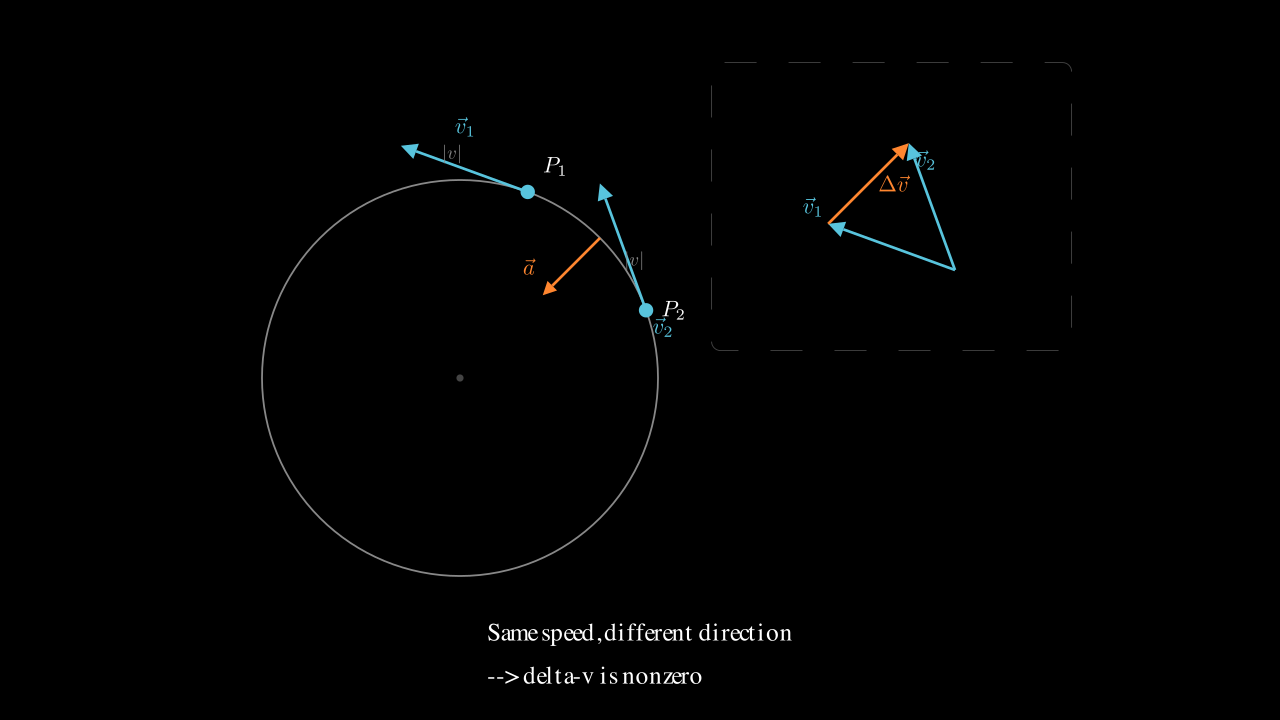
Many people believe that "acceleration" means "speeding up." Under this belief, slowing down is "deceleration" (a different thing), and constant speed means no acceleration. This everyday definition is not what physicists mean.
In physics, acceleration is any change in velocity -- speeding up, slowing down, or changing direction. All of these involve a change in velocity, and therefore all involve acceleration.
Let's test this carefully.
Misconception Challenge: Classify each scenario as "speeding up," "slowing down," or "changing direction." Then decide: is there acceleration?
Scenario Speeding up, slowing down, or changing direction? Is there acceleration? A ball rolling to the right, getting faster A ball rolling to the right, getting slower A car going around a circular track at constant speed A pendulum at the very bottom of its swing (moving fastest) Commit your answers before revealing the solution below.
Reveal: Acceleration is present in all four scenarios.
- The ball speeding up: velocity is increasing, so $\frac{dv}{dt} > 0$. Acceleration: yes.
- The ball slowing down: velocity is decreasing, so $\frac{dv}{dt} < 0$. Acceleration: yes.
- The car on a circular track: the speed is constant, but the direction of velocity is continuously changing. The velocity vector is rotating. Acceleration: yes.
- The pendulum at the bottom: the speed is momentarily at its maximum (so the rate of change of speed is zero at that instant), but the direction of the velocity is changing as it swings through the arc. Acceleration: yes.
The key insight: velocity is a vector. It has both magnitude (speed) and direction. A change in either one counts as a change in velocity, and therefore counts as acceleration.
Now go back to your prediction. The correct answer was (c) All three -- A, B, and C. If you got this right, you already had the physicist's definition. If not, welcome to one of the most important conceptual shifts in mechanics.
Non-Examples: Sharpening the Boundary
To make the definition sharper, consider what zero acceleration looks like:
- A car driving at constant velocity on a straight road: Velocity is not changing -- neither speed nor direction. Acceleration is zero.
- An object at rest, sitting on a table: Velocity is zero and stays zero. Acceleration is zero.
Now compare with something that looks like zero acceleration but isn't:
- A car driving at constant speed on a circular track: Speed is constant, but direction is changing. Velocity is changing. Acceleration is not zero.
The non-example sharpens the concept. Constant speed does not guarantee zero acceleration. Constant velocity (both speed and direction unchanged) does.
A Worked Example
Let's make this concrete with a computation.
Problem: A particle moves along a straight line with velocity
$$v(t) = 3t^2 - 12t + 9 \quad \text{(m/s)}$$
Find the acceleration as a function of time, and determine when the acceleration is zero.
Solution:
Acceleration is the derivative of velocity:
$$a(t) = \frac{dv}{dt} = \frac{d}{dt}\left(3t^2 - 12t + 9\right) = 6t - 12 \quad \text{(m/s}^2\text{)}$$
Setting $a(t) = 0$:
$$6t - 12 = 0 \implies t = 2 \text{ s}$$
At $t = 2$ s, the acceleration is zero. What is the velocity at that moment?
$$v(2) = 3(4) - 12(2) + 9 = 12 - 24 + 9 = -3 \text{ m/s}$$
So at the moment the acceleration is zero, the object is still moving (at $-3$ m/s, meaning in the negative direction). Zero acceleration does not mean the object has stopped. It means the velocity has momentarily stopped changing.
Check your understanding: At $t = 2$ s, is the object speeding up or slowing down? Think about this before reading on.
Hint: Consider the signs of both $v(t)$ and $a(t)$ near $t = 2$ s. Just before $t = 2$, the acceleration is negative (check: $a(1) = 6(1) - 12 = -6$). The velocity at $t = 1$ is $v(1) = 3 - 12 + 9 = 0$. The object is momentarily at rest at $t = 1$, then moves in the negative direction with negative velocity. The acceleration at $t = 2$ is zero, meaning the velocity is at a local extremum -- it's the most negative it gets. After $t = 2$, the acceleration becomes positive, and the velocity starts increasing (becoming less negative, eventually positive).
Practice Layers
Layer 1: Concrete -- Compute Acceleration from Velocity
Problem 1. Given $v(t) = 5t^3 - 2t + 7$, find $a(t)$.
Work this out, then check: $a(t) = 15t^2 - 2$.
Problem 2. A particle has velocity $v(t) = 20 - 4t$ (m/s). Find the acceleration. Is it constant? At what time does the particle stop?
Check: $a(t) = -4$ m/s$^2$ (constant and negative). The particle stops when $v = 0$, so $t = 5$ s.
Problem 3. Given $v(t) = 10\sin(2t)$, find $a(t)$ and evaluate it at $t = \pi/4$.
Check: $a(t) = 20\cos(2t)$. At $t = \pi/4$: $a(\pi/4) = 20\cos(\pi/2) = 0$.
Layer 2: Pattern -- Reading Acceleration from Graphs
[Interactive: An $a(t)$ graph is shown (piecewise: positive constant for $0 < t < 2$, zero for $2 < t < 4$, negative constant for $4 < t < 6$). Students are asked to describe what the object is doing in each interval by selecting from descriptions.]
For each interval, describe the object's motion:
(a) $0 < t < 2$: acceleration is positive and constant. What is happening to the velocity?
(b) $2 < t < 4$: acceleration is zero. What is happening to the velocity?
(c) $4 < t < 6$: acceleration is negative and constant. What is happening to the velocity?
Key insight: Positive acceleration means velocity is increasing. Zero acceleration means velocity is constant. Negative acceleration means velocity is decreasing. But "velocity is decreasing" does not automatically mean "the object is slowing down" -- that depends on whether velocity and acceleration have the same or opposite signs.
Layer 3: Structure -- Acceleration Without Speed Change
Problem: Can acceleration be nonzero when speed is constant? Explain with a physical example, and describe what must be happening to the velocity for this to occur.
This is the core structural question of this section. Speed is the magnitude of velocity. Acceleration measures the rate of change of the full velocity vector. If only the direction of velocity is changing (not the magnitude), the speed is constant but the acceleration is nonzero.
Physical example: A car driving at a steady 60 km/h around a circular track. The speed never changes, but the velocity vector is constantly rotating. The acceleration vector points toward the center of the circle. You will study this in detail when you reach uniform circular motion later in the course.
Layer 4: Debug -- Finding Counterexamples
A student says: "The acceleration is negative, so the object is slowing down."
Find a counterexample -- a situation where the acceleration is negative but the object is speeding up.
Take a moment to think about this before reading the answer.
Counterexample: An object moving in the negative $x$-direction (negative velocity) with negative acceleration. For instance, $v = -5$ m/s and $a = -3$ m/s$^2$. The velocity is becoming more negative -- going from $-5$ to $-8$ to $-11$ m/s. The speed (the magnitude of velocity) is increasing: 5, 8, 11 m/s. The object is speeding up, even though the acceleration is negative.
The rule: an object speeds up when velocity and acceleration have the same sign, and slows down when they have opposite signs. The sign of acceleration alone doesn't tell you whether the object is speeding up or slowing down -- you need to know the sign of velocity too.
| $v$ | $a$ | What happens to speed? |
|---|---|---|
| $+$ | $+$ | Speeding up |
| $+$ | $-$ | Slowing down |
| $-$ | $-$ | Speeding up |
| $-$ | $+$ | Slowing down |
MathBox Visualization
Bringing It Together: Position, Velocity, Acceleration
Here is the full derivative chain for one-dimensional motion:
$$x(t) \xrightarrow{\frac{d}{dt}} v(t) \xrightarrow{\frac{d}{dt}} a(t)$$
Each derivative peels back another layer of the motion. Position tells you where. Velocity tells you how the "where" is changing. Acceleration tells you how the "how" is changing.
[Interactive: Enter a position function $x(t)$ (e.g., $x(t) = t^3 - 6t^2 + 9t$). The component displays three synchronized graphs: $x(t)$, $v(t)$, and $a(t)$, stacked vertically. A vertical time cursor sweeps across all three graphs simultaneously. Students can drag the cursor to any time and read off all three values. Guided prompts: "Find a time where $v = 0$ but $a \neq 0$. What is the object doing at that moment?" and "Find a time where $a = 0$. Is the velocity at a maximum or minimum there?"]
MathBox Visualization
Reflection
Before this lesson, what did you think "acceleration" meant? Has your definition changed?
Write down your new definition in one sentence. Then compare it to this one: Acceleration is the rate at which velocity changes, and velocity can change in magnitude, direction, or both.
If you previously thought "acceleration = speeding up," you're not alone -- that's one of the most common misconceptions in physics, and even experienced students sometimes slip back into it. The test: whenever you hear "acceleration," ask yourself, "Is the velocity changing?" -- not "Is the speed changing?"
Looking Ahead
You now have the complete kinematic description of motion through calculus: position, velocity, and acceleration, each connected to the next by differentiation. In Section 1.7, you will practice translating between these three quantities across all their representations -- graphs, equations, data tables, and physical descriptions -- bringing together everything from this chapter into a unified picture.
But there is a question we haven't yet answered: if acceleration tells you how velocity changes, what determines the acceleration itself? That question -- what causes acceleration -- is the doorway into dynamics, and it will be answered by Newton's second law when we reach Chapter 2.
For now, the key takeaway is this: the same calculus operation (the derivative) that turned position into velocity also turns velocity into acceleration. One idea, applied twice, gives you the complete mathematical language of how motion evolves.