1.2 — The Shape of $y = x^2$
Starting Simple
In the last section, we discovered that quadratic expressions like $y = ax^2 + bx + c$ can model situations where the rate of change itself changes at a constant rate. We found a specific equation — $y = -5t^2 + 20t + 2$ — that fit the ball's trajectory perfectly.
But that equation has three moving parts. Before we can understand what each coefficient does, we need to study the simplest possible quadratic:
$$y = x^2$$
No $b$. No $c$. Just $x$, squared. Everything we learn about this "parent function" will carry over to every quadratic we'll ever meet.
Plotting $y = x^2$ from a Table
Let's build the graph by hand. Pick several values of $x$, compute $x^2$, and plot the results.
| $x$ | $-3$ | $-2$ | $-1$ | $0$ | $1$ | $2$ | $3$ |
|---|---|---|---|---|---|---|---|
| $y = x^2$ | $9$ | $4$ | $1$ | $0$ | $1$ | $4$ | $9$ |
Before reading on, look at this table. What patterns do you notice? Take a moment — there's something striking here.
What to notice
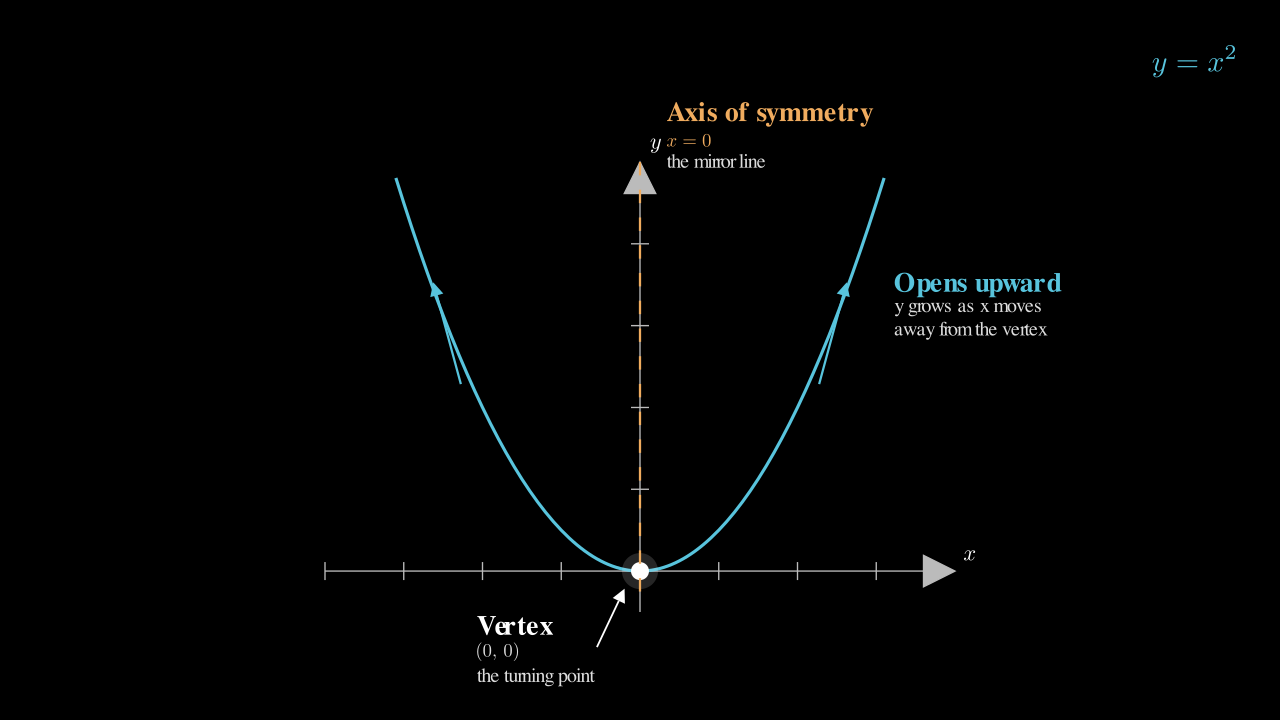
The outputs on the left side are a mirror image of the outputs on the right side. $x = -3$ and $x = 3$ both give $y = 9$. $x = -2$ and $x = 2$ both give $y = 4$. Every input and its negative produce the same output.When you plot these points on a coordinate plane and connect them with a smooth curve, you get a shape called a parabola — a U-shaped curve that dips down to a lowest point and then rises back up on both sides.
This is the most important curve in this entire course. Let's understand it thoroughly.
Symmetry: The Parabola Is Its Own Mirror Image
The pattern in the table wasn't a coincidence. For the function $y = x^2$, whenever you plug in $x$ or $-x$, you get the same result:
$$(-x)^2 = x^2$$
Squaring erases the sign. This means the graph is perfectly symmetric: the left half is a mirror reflection of the right half.
The mirror line runs vertically through $x = 0$ — straight through the bottom of the curve. If you folded the graph along this line, the two halves would land exactly on top of each other.
This isn't just a visual curiosity. Symmetry is a structural feature of parabolas. It means:
- If you know the right half of the graph, you automatically know the left half.
- If the parabola crosses the $x$-axis at one point, there's a matching crossing on the other side (at equal distance from the mirror line).
- The highest or lowest point of the curve sits exactly on the mirror line.
We'll use these facts constantly. Symmetry cuts the work of understanding a parabola in half — literally.
MathBox Visualization
Key Vocabulary
Now that we've seen the shape, let's name its parts. There are exactly three terms to know:
Vertex. The lowest point (or highest, for downward-opening parabolas) of the curve. For $y = x^2$, the vertex is at $(0, 0)$. It's the "turning point" — where the curve stops going down and starts going up.
Axis of symmetry. The vertical line that acts as the mirror. For $y = x^2$, this is the line $x = 0$ (the $y$-axis). The vertex always sits on the axis of symmetry.
Opening direction. The parabola $y = x^2$ opens upward — it makes a U shape, and $y$ values grow without bound as $x$ moves away from the vertex in either direction.
Connection to what you know: Think of the vertex like the $y$-intercept of a line — it's a single special point that anchors the graph. And the axis of symmetry is like having a built-in rule that tells you: once you've plotted one side, the other side is free.
Check your understanding
For the parabola $y = x^2$:
(a) What is the $y$-value at the vertex?
(b) If you know that $y = 25$ when $x = 5$, what other $x$-value also gives $y = 25$?
(c) Can $y$ ever be negative?
Check your answer
(a) $y = 0$ at the vertex $(0, 0)$. (b) $x = -5$, by symmetry. (c) No. Since $y = x^2$ and any real number squared is non-negative, $y \geq 0$ for all $x$.How $a$ Controls the Parabola
Now let's take one step beyond the parent function. Consider the family of quadratics $y = ax^2$, where $a$ is a constant. What happens as we change $a$?
Changing the width: $a = 2$ vs. $a = \tfrac{1}{2}$
Let's compare three functions side by side:
| $x$ | $y = \tfrac{1}{2}x^2$ | $y = x^2$ | $y = 2x^2$ |
|---|---|---|---|
| $0$ | $0$ | $0$ | $0$ |
| $1$ | $0.5$ | $1$ | $2$ |
| $2$ | $2$ | $4$ | $8$ |
| $3$ | $4.5$ | $9$ | $18$ |
Look at the row $x = 2$. For $y = \tfrac{1}{2}x^2$, the output is $2$. For $y = x^2$, it's $4$. For $y = 2x^2$, it's $8$. All three parabolas pass through the origin, but they rise at very different rates.
When $|a|$ is larger, the parabola is narrower — it shoots up (or down) more steeply. When $|a|$ is smaller (but still positive), the parabola is wider — it rises more gently.
Think of it this way: $a$ is a multiplier applied to every $x^2$ value. Doubling $a$ doubles every height, which pulls the curve inward. Halving $a$ halves every height, which lets the curve spread out.
Flipping the direction: $a = -1$
What happens when $a$ is negative? Let's compute $y = -x^2$:
| $x$ | $-3$ | $-2$ | $-1$ | $0$ | $1$ | $2$ | $3$ |
|---|---|---|---|---|---|---|---|
| $y = -x^2$ | $-9$ | $-4$ | $-1$ | $0$ | $-1$ | $-4$ | $-9$ |
Every output is the negative of what $y = x^2$ produces. The curve is a mirror image — but this time reflected across the $x$-axis. Instead of a U, it's an upside-down U: the vertex at $(0, 0)$ is now the highest point, and the curve falls away in both directions.
The parabola opens downward.
Remember the ball from section 1.1? Its equation was $y = -5t^2 + 20t + 2$. The leading coefficient was $a = -5$ — negative. That's why the ball goes up and then comes back down: the parabola opens downward, and the vertex is the peak of its flight.
Summary: what $a$ tells you
The coefficient $a$ in $y = ax^2$ controls two things at once:
- Sign of $a$: Positive means the parabola opens upward (U shape). Negative means it opens downward (inverted U).
- Size of $|a|$: Larger $|a|$ means a narrower parabola (steeper sides). Smaller $|a|$ means a wider parabola (gentler sides).
One thing $a$ cannot do: it never moves the vertex. For $y = ax^2$, the vertex is always at the origin, no matter what $a$ is. (Moving the vertex requires the $b$ and $c$ terms — that's coming in the next chapter.)
Why $a = 0$ is excluded: If $a = 0$, then $y = ax^2$ becomes $y = 0$ — a horizontal line, not a parabola. For a quadratic to be genuinely quadratic, we need $a \neq 0$.
Check your understanding
Without plotting, decide: which parabola is narrower, $y = 3x^2$ or $y = 10x^2$?
And which opens downward, $y = 5x^2$ or $y = -\tfrac{1}{3}x^2$?
Check your answer
$y = 10x^2$ is narrower because $|10| > |3|$ — it grows faster. $y = -\tfrac{1}{3}x^2$ opens downward because the coefficient is negative.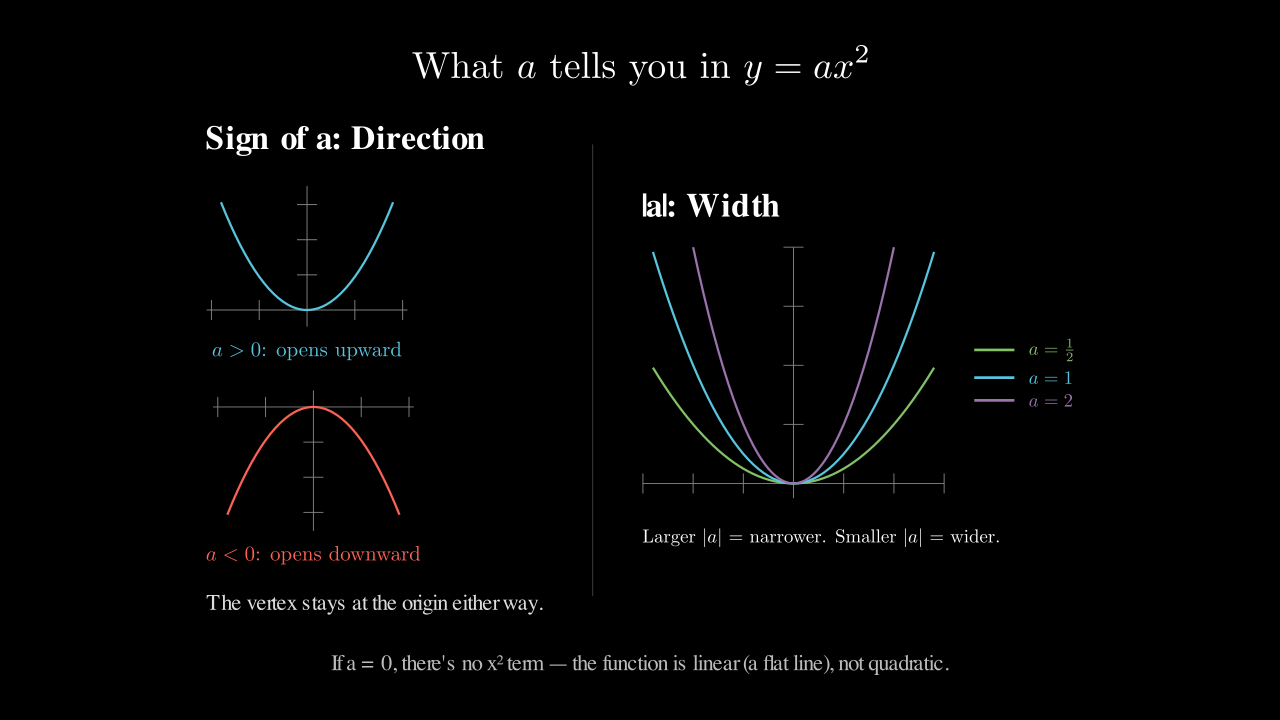
MathBox Visualization
Reflection
Let's name what we've built in this section.
We started with the simplest quadratic, $y = x^2$, and studied its graph — a parabola. We discovered that it has a built-in symmetry: the left side mirrors the right. We named the key features: the vertex (the turning point), the axis of symmetry (the mirror line), and the opening direction (up or down).
Then we explored what happens when we introduce a single coefficient: $y = ax^2$. This one number controls both the width and the direction of the parabola.
What we learned: Every parabola is symmetric, and the coefficient $a$ determines its shape. A positive $a$ opens upward, a negative $a$ opens downward, and the size of $|a|$ controls how steep the curve is. The simplest parabola, $y = x^2$, is the foundation — every other quadratic is a transformation of this one shape.
Practice
Problem 1 — Concrete. Fill in the table for $y = 3x^2$:
| $x$ | $-2$ | $-1$ | $0$ | $1$ | $2$ |
|---|---|---|---|---|---|
| $y$ | ? | ? | ? | ? | ? |
Then answer: What is the vertex? What is the axis of symmetry?
Solution
| $x$ | $-2$ | $-1$ | $0$ | $1$ | $2$ | |:---:|:---:|:---:|:---:|:---:|:---:| | $y$ | $12$ | $3$ | $0$ | $3$ | $12$ | The vertex is $(0, 0)$. The axis of symmetry is $x = 0$.Problem 2 — Pattern. Without computing any values, rank these parabolas from widest to narrowest:
$$y = 4x^2, \qquad y = \tfrac{1}{4}x^2, \qquad y = x^2, \qquad y = 7x^2$$
Solution
Widest to narrowest: $y = \tfrac{1}{4}x^2$, $y = x^2$, $y = 4x^2$, $y = 7x^2$. Smaller $|a|$ means wider; larger $|a|$ means narrower.Problem 3 — Variation. Consider the three functions below. For each, state the vertex, axis of symmetry, and opening direction.
(a) $y = 6x^2$
(b) $y = -6x^2$
(c) $y = -\tfrac{1}{6}x^2$
Solution
All three have vertex $(0, 0)$ and axis of symmetry $x = 0$ — changing $a$ alone doesn't move the vertex. (a) Opens **upward** (positive $a$). Narrow (large $|a|$). (b) Opens **downward** (negative $a$). Narrow (large $|a|$). Same shape as (a) but flipped upside down. (c) Opens **downward** (negative $a$). Wide (small $|a|$).Problem 4 — Debug. A student says: "$y = -2x^2$ has its vertex below the $x$-axis because the negative sign pulls it down." Is this correct?
Solution
No. The vertex of $y = -2x^2$ is at $(0, 0)$, which is *on* the $x$-axis. The negative sign doesn't move the vertex — it flips the **opening direction**. The parabola opens downward, so all other points on the curve are below the vertex, but the vertex itself stays at the origin.Problem 5 — Transfer. A diver jumps from a platform. Ignoring horizontal motion, their height above the water is modeled by $y = -5t^2$ (starting from the edge of the platform, which we call height $0$).
(a) Does the parabola open upward or downward? Does this make physical sense?
(b) What is the diver's height at $t = 1$ second? At $t = 2$ seconds?
(c) Using symmetry, if the diver is at height $-5$ at $t = 1$, is there another time when they're at the same height? What does this mean physically?
Solution
(a) The parabola opens **downward** (since $a = -5 < 0$). This makes sense: the diver is falling, so their height decreases over time. (b) At $t = 1$: $y = -5(1) = -5$ meters (5 meters below the platform). At $t = 2$: $y = -5(4) = -20$ meters. (c) By the algebra, $y = -5t^2 = -5$ also when $t = -1$. But $t = -1$ means one second *before* the jump, which doesn't apply here. Physically, the model only makes sense for $t \geq 0$. This is a good reminder: symmetry in the math doesn't always mean symmetry in the real situation. The domain matters.What's Next
We've now built a solid understanding of the simplest parabola $y = x^2$ and how the coefficient $a$ stretches, compresses, and flips it. But so far, every parabola we've studied has its vertex locked at the origin. In the next chapter, we'll discover how the remaining coefficients $b$ and $c$ — and a powerful form called vertex form — let us move the parabola anywhere we want.